
Bentley Didn't Choose Inefficiency. They Chose Control.
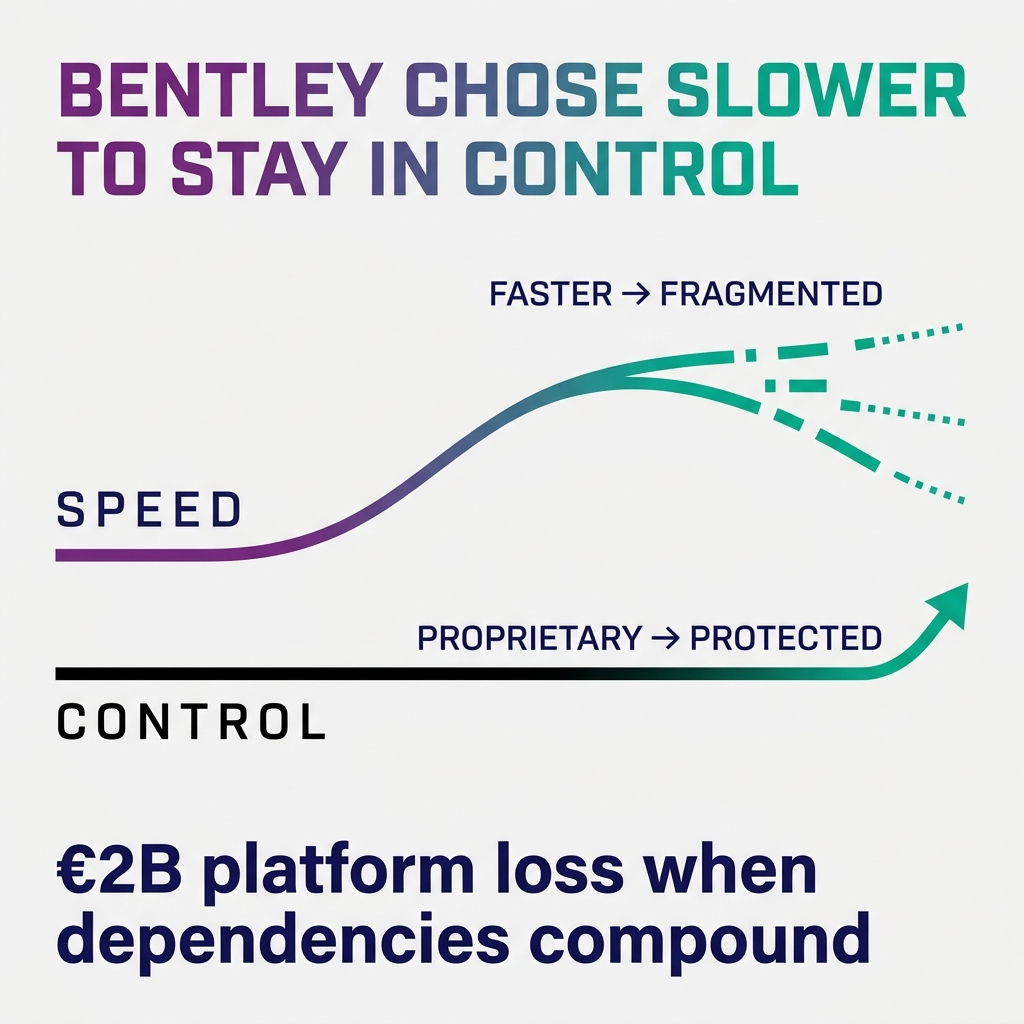
Bentley's recent product and platform decisions may look sub-optimal on cost and speed. Volkswagen Group's partnerships with Chinese technology firms, through SAIC and XPeng, offer access to faster and lower-cost electrification components. Bentley ruled them out. Its CEO was direct about why: "people are looking for a British luxury car." The brand is proceeding instead with its own hybridised architecture, what Walliser himself calls a range extender, a 4.0-litre twin-turbo V8 paired with a small battery, delivering around 80 kilometres of electric-only range.
But that framing misreads the decision logic.
The choice is not primarily about performance. It is about control over system architecture. And in long-cycle, capital-intensive industries, early platform decisions tend to evolve from technical optimisations into structural determinants of future adaptability. Most organisations don't model that cascade when they make the call.
Speed Is a First-Order Advantage and a Second-Order Constraint
The global automotive industry is undergoing a step-change in development velocity, driven in large part by vertically integrated Chinese supply ecosystems.
To see what Bentley is walking away from, look at what that speed delivers. Volkswagen Group is launching a new electric vehicle every two weeks in 2026 through deep integration with the Chinese supply chain, reaching series production maturity in 24 months. The industry now calls it "China Speed." On paper, it's a clear advantage.
But speed is not neutral. It is a first-order gain that introduces second-order constraints.
Where core systems are externally sourced, accelerated delivery is achieved through deeper integration with supplier architectures. That creates implicit dependencies across three dimensions: programme timing, system adaptability, and product differentiation logic. These dependencies are not visible at inception. They become material only when the system has to evolve under changing regulatory, technological, or market conditions. And in long-cycle industries, that always happens.
Dependency Is a Structural Variable, Not an Operational One
Conventional programme management treats dependency as an operational risk to be mitigated. In reality, dependency functions as a structural variable that governs decision autonomy over time.
Every external system dependency adds a layer you don't fully see, a timeline you don't control, and a decision you can't make unilaterally. Individually, each is manageable. Collectively, they aggregate into system-level rigidity.
As dependency density rises, the strategic question shifts. It is no longer "are we on track?" It is "can we still change direction without breaking the system?" At high levels of dependency, adaptability stops being a programme attribute and becomes a function of external coordination.
From Hierarchical Supply Chains to Network Architectures
The transition to electric vehicles is accelerating a structural reconfiguration of the automotive value chain.
The industry historically operated through hierarchical supply chains with clear OEM-centric control over architecture. That structure is giving way to distributed networks in which battery systems, power electronics, software layers, and thermal and energy management are increasingly developed and optimised outside traditional OEM boundaries.
The shift shows up in the economics. The share of an EV's value added by component suppliers might total 35% to 40%, compared with 50% to 55% on an ICE-powered car. Value creation is migrating towards component and system suppliers, with OEMs progressively assuming the role of system integrators rather than system architects. That is not only a redistribution of value. It is a redistribution of control over product behaviour.
By 2028, suppliers will be servicing more than 200 individual automotive architectures globally, a 117% increase from 2020. As distinct architectures proliferate, interoperability requirements expand, integration complexity rises, and the cost of late-stage design change climbs with it. Unless you control the architecture yourself.
Platform Lock-In as Deferred Structural Cost
Bentley's first full EV sits on Volkswagen Group's Premium Platform Electric (PPE), a dedicated electric architecture not designed for multi-powertrain flexibility and not re-engineerable to take combustion or plug-in hybrid drivetrains. A decision like that is a structural commitment, not a purely technical choice.
When Volkswagen Group discontinued the SSP-61 platform, the result was an impairment loss and outstanding obligations of 2 billion euros, shared between Porsche and VW Group's Progressive brand group, which includes Bentley, Audi, Lamborghini and Ducati.
The key dynamic is temporal decoupling. The benefits of platform standardisation are realised in early-cycle efficiency. The costs of rigidity emerge in later-cycle adaptation constraints. That delayed cost structure means the trade-off becomes visible only when environmental conditions shift, which is to say, when reality diverges from the assumptions the platform was built on. That is the real cost of dependency. Not inefficiency. Irreversibility.
It also explains where Bentley's flexibility now comes from. The brand is extending hybrid and internal combustion models beyond 2035 in response to EU regulatory changes and slower EV growth, and it can do that because it is prioritising the powertrain it controls. The shared platform bit the group once. The powertrain Bentley owns is where the room to adapt lives.
Differentiation in Luxury Is Systemic, Not Aesthetic
The economics of mass-market and luxury production diverge fundamentally. Mass-market strategies optimise for cost efficiency and throughput. Luxury strategies optimise for controlled differentiation and behavioural consistency across product systems.
In that context, differentiation is not primarily aesthetic. It is systemic. It depends on control over power delivery characteristics, software behaviour and update logic, thermal and energy management, and integration architecture across subsystems. When those elements are defined externally or through shared platforms, differentiation is constrained by the lowest common denominator of shared system design. At that point you are no longer a manufacturer. You are assembling someone else's architecture.
Lucid resolved this tension by internalising it. They made their proprietary battery and drive units, over-the-air updates, and in-house software platforms central selling points, positioning the brand as a vertically integrated technology company rather than just another EV builder. That is the strategic bet: control over the components that define the product equals brand protection.
Bentley's Position: Control as Optionality Preservation
Bentley's hybridised architecture is best read not as a transitional compromise but as an explicit optimisation for optionality retention.
By keeping control over its core powertrain architecture, Bentley preserves the ability to adjust powertrain strategy independent of external platform evolution, to reconfigure system-level trade-offs under regulatory change, and to retain internal ownership of the performance characteristics that define the brand.
The 80-kilometre electric range is therefore a by-product of architectural choice, not the design objective. The strategic value lies in retained decision autonomy under future uncertainty.
Two Diverging Execution Models
The industry is bifurcating into two execution models.
The first is integrated speed: rapid product cadence achieved through deep external system integration. That is the right strategy when competitive advantage comes from volume and price positioning.
The second is controlled architecture: slower development cycles with higher internal system ownership. That is the right strategy when advantage comes from differentiation that cannot be replicated through shared platforms.
The two are not distinguished by performance in steady-state conditions. They are distinguished by resilience under structural change. Both work until the environment changes. Then only one can adapt without breaking. The relevant strategic variable is not speed or cost in isolation. It is the degree of architectural control the OEM retains.
Control as the Constraint Variable
In environments defined by long development cycles, high capital intensity, and rapid technological transition, control over architecture becomes the constraint variable that governs the range of future strategic options. Efficiency, in that context, is not absolute. It is conditional on the preservation of adaptability.
So the central question is not whether faster execution is preferable. It is whether increased execution speed introduces irreversible constraints on future decision-making.
Bentley's position reflects a clear prioritisation. Not efficiency over inefficiency, but control over dependency. And in multi-cycle industries, control is not an optimisation variable. It is the constraint that determines whether everything else still works.
Comments ()