
Stable Interaction Under Persistent Disagreement

Human civilisation rests on a strange capability. Every day, billions of people make decisions with incomplete information, conflicting objectives, and very different interpretations of reality.
Drivers negotiate traffic.
Investors price markets.
Suppliers coordinate supply chains.
Nations navigate geopolitical tension.
Most of the time, these systems remain stable.
This stability is often credited to information, rules, institutions, or incentives. Yet none of these explanations fully match what we see in practice.
People often have access to the same information and still reach different conclusions. They disagree about causes, intentions, priorities, risks, and outcomes. And still, coordination happens.
The real question is not why people agree. The real question is why they continue to coordinate even when they do not.
Coordination does not require agreement. It requires predictability.
This distinction matters. Much of modern management, economics, artificial intelligence, and systems theory quietly assumes that coordination comes from alignment. The usual sequence looks like this:
Observe reality.
Interpret reality.
Align understanding.
Coordinate action.
The logic feels natural. Yet many of the world’s most reliable systems work without consensus. What they achieve instead is something far more practical.
They achieve predictability.
The Hidden Assumption Behind Coordination
Most coordination models treat disagreement as a problem that must be removed.
Align the incentives.
Align the objectives.
Align the information.
Align the mental models.
The expectation is that more alignment produces more stability.
Sometimes it does.
Often it does not.
Real systems show a different pattern. People rarely hold identical beliefs.
A pedestrian and a driver at the same crossing may see the situation differently.
A buyer and a seller rarely agree on the true value of an asset.
Engineering, manufacturing, and procurement often hold different views of programme reality.
Political rivals almost never share a common interpretation of events.
Yet coordination often succeeds.
Not because beliefs converge.
Because expectations converge.
Participants become predictable enough to one another for the interaction to continue.
This leads to a different proposition:
Coordination does not require agreement.
It requires expectations that are aligned enough to forecast what happens next.
The distinction looks subtle. Its implications are not.
What Indian Roads Reveal
Highly structured environments hide the real coordination mechanism.
A motorway in Germany, a freeway in Phoenix, or a controlled intersection in Singapore carries much of the coordination load through infrastructure. Traffic lights communicate. Lane markings constrain movement. Right of way rules resolve ambiguity. Participants inherit order from the environment. The road itself performs a large share of the cognitive work.
Indian roads reveal a different reality.
At an unsignalised junction in Hyderabad, Pune, Bengaluru, or Delhi, many of these supports weaken or disappear. The environment becomes information rich but rule light.
A motorcycle moves into a gap before it formally exists.
A pedestrian begins crossing without explicit permission.
A vehicle negotiates passage through small changes in speed and position.
To an outsider, the scene looks chaotic. In practice, it is often highly coordinated.
Participants are constantly forecasting one another. They are not agreeing. They are predicting.
This is why Indian roads matter. Not because they are difficult. They matter because they reveal a coordination mechanism that more structured environments hide. They show stable interaction under persistent disagreement.
Beliefs and Expectations Are Not the Same Thing
Most coordination failures are described as failures of understanding.
People misunderstood one another.
People lacked information.
People reached the wrong conclusion.
But understanding and predictability are not the same.
Beliefs are internal.
Expectations are relational.
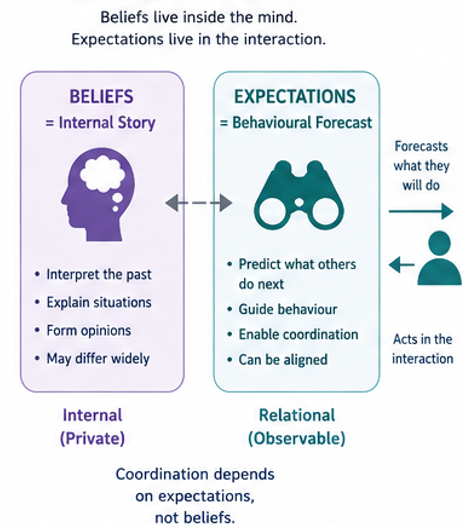
A belief answers the question: What do I think is true.
An expectation answers a different question: What do I think you will do next.
Two participants may hold completely different beliefs while maintaining highly aligned expectations.
A driver may believe they have priority.
A pedestrian may believe they have priority.
Those beliefs remain incompatible.
Yet both may expect the driver to slow and the pedestrian to cross.
The interaction succeeds.
The beliefs never converged.
The expectations did.
This distinction explains why many systems remain stable despite disagreement. Participants are not operating from a shared reality. They are operating from a shared forecast.
The Predictability Window
Every interaction exists within a finite region of predictability. Inside that region, participants have enough confidence in one another’s behaviour to coordinate. Outside it, coordination becomes fragile.
This region can be understood as the Predictability Window.
The window exists where two conditions overlap.
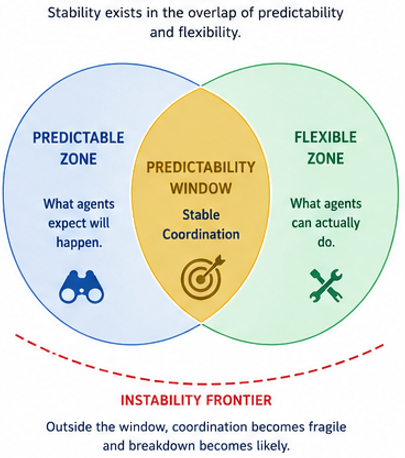
First, participants remain predictable enough to one another.
Second, enough feasible actions remain available for adaptation.
As long as both conditions hold, disagreement can be tolerated. Once either begins to collapse, stability weakens. Once both collapse at the same time, breakdown becomes likely.
This explains why instability rarely appears suddenly.
Most systems move through recognisable stages.
The ability to predict others weakens.
Available options shrink.
Recovery paths disappear.
Coordination effort increases.
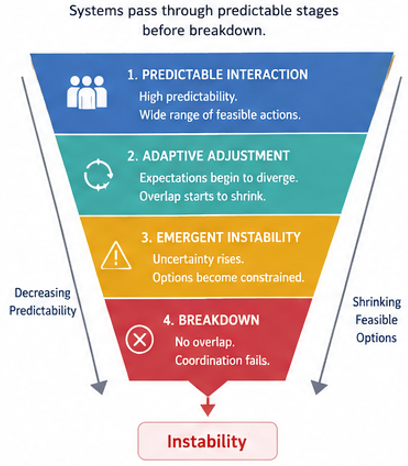
Only later does the visible failure occur.
By the time a deadline is missed, a collision occurs, a negotiation collapses, or a crisis emerges, the underlying coordination failure has usually been developing for some time.
Why Systems Actually Fail
Traditional explanations for failure focus on information deficits.
Someone did not know.
Someone did not communicate.
Someone missed a signal.
These explanations are often correct but incomplete.
Many failures occur even when information is abundant.
The problem is not information scarcity.
The problem is expectation divergence.
Participants construct different forecasts of what others will do. As those forecasts diverge, coordination becomes harder. Eventually, participants begin responding to different imagined futures. Their actions reinforce divergence rather than reduce it.
The system enters a self amplifying loop.
Performance may still look healthy.
Status reports may still be green.
Metrics may still appear stable.
Yet the underlying coordination fabric is weakening.
The visible breakdown is only the first symptom. The failure began much earlier.
The Implications for Leadership
Most organisations monitor outcomes. Very few monitor predictability.
This may become one of the most important distinctions in modern management.
Performance metrics are usually lagging indicators. Predictability metrics are often leading indicators.
When teams become less predictable to one another, coordination costs rise.
Workarounds appear.
Escalations increase.
Decision latency grows.
Informal recovery mechanisms multiply.
These signals often appear long before performance deteriorates.
This suggests four practical priorities.
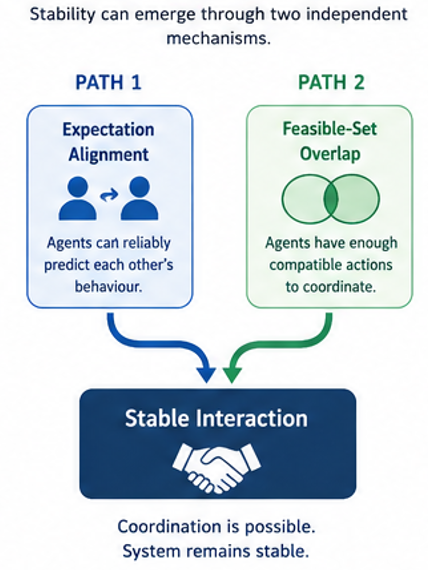
Monitor Predictability
Do not measure only what happened.
Measure how confidently participants can forecast one another’s actions.
Preserve Optionality
Highly efficient systems often remove flexibility.
Resilient systems preserve alternative paths.
Feasible set overlap matters.
Make Expectations Explicit
Many coordination failures begin with assumptions that remain unspoken.
Invisible expectations cannot be aligned.
Watch for Early Warning Signals
Behavioural variance.
Conflicting forecasts.
Increasing coordination effort.
Compensatory processes.
These are often signs that the Predictability Window is narrowing.
Beyond Roads
The significance of Indian roads is not transportation. It is revelation.
They expose a coordination principle that appears across human systems.
Financial markets function despite disagreement.
Diplomacy functions despite disagreement.
Organisations function despite disagreement.
Civilisation itself functions despite disagreement.
The common factor is not consensus.
It is predictability.
Participants do not need identical beliefs.
They need expectations that are aligned enough to avoid destructive conflict.
This is a different way of thinking about stability.
Not as agreement.
Not as control.
Not as perfect information.
But as the preservation of predictable interaction.
A Different Definition of Stability
For decades, stability has often been defined as the absence of disagreement. That definition is difficult to defend in a world shaped by complexity, interdependence, and diverse perspectives.
A more useful definition is this:
Stability is the ability of participants to remain predictable to one another despite persistent disagreement.
This definition is more realistic and more demanding. It accepts that consensus is often impossible. It recognises that disagreement is normal. And it shifts attention toward the mechanism that actually allows complex systems to function.
The future may belong not to the organisations that achieve perfect alignment, but to those that become exceptionally good at preserving predictability when agreement is impossible.
Civilisation does not run on consensus.
It runs on the ability of people to remain predictable to one another despite persistent disagreement.
Signetra Foresights publishes independent analysis on complex systems, coordination, execution, and the hidden dynamics that determine how outcomes emerge.
Comments ()