
The EU Battery Passport Isn't a Compliance Problem. It's a Validation Saturation Problem.
The automotive industry is already operating at the edge of its validation capacity. UNECE regulations. WLTP. Euro 7. ISO 26262. ASPICE. WP.29 cybersecurity. ELV directive. CSRD. And now the Battery Passport, mandatory by 2027.
Each of these arrived with the same logic. The regulation is necessary. The data is achievable. The timeline is reasonable.
What none of them account for is the compounding effect.
Vehicle programmes that entered planning in 2022 are now mid-validation. Some are within twelve months of Job 1. They were architected against the compliance landscape that existed when the programme was approved. The Battery Passport changes that landscape after the architectural decisions have been made, after supplier contracts have been signed, after validation cycles have begun.
This isn't a question of whether the regulation is correct. The traceability and lifecycle accountability the Battery Passport demands are defensible objectives. The question is what happens when you add a new compliance layer to an industry whose validation infrastructure is already stretched, whose programmes are already in-flight, and whose supplier base is already absorbing the cost of every previous regulatory cycle.
Most of Your Battery Passport Data Lives Outside Your Walls
The answer, in my experience, is that something has to give. Usually it's the verification quality, the launch timeline, or the supplier margin. Sometimes all three.
The regulation is not arriving into an empty system.
Here's what the regulation requires.
Every EV battery, light transport battery, and industrial battery over 2kWh sold in the EU needs a digital passport. The passport must contain verified information on battery chemistry, materials sourcing, carbon footprint, and recycling processes.
The complexity isn't in the list. The complexity is in the structure.
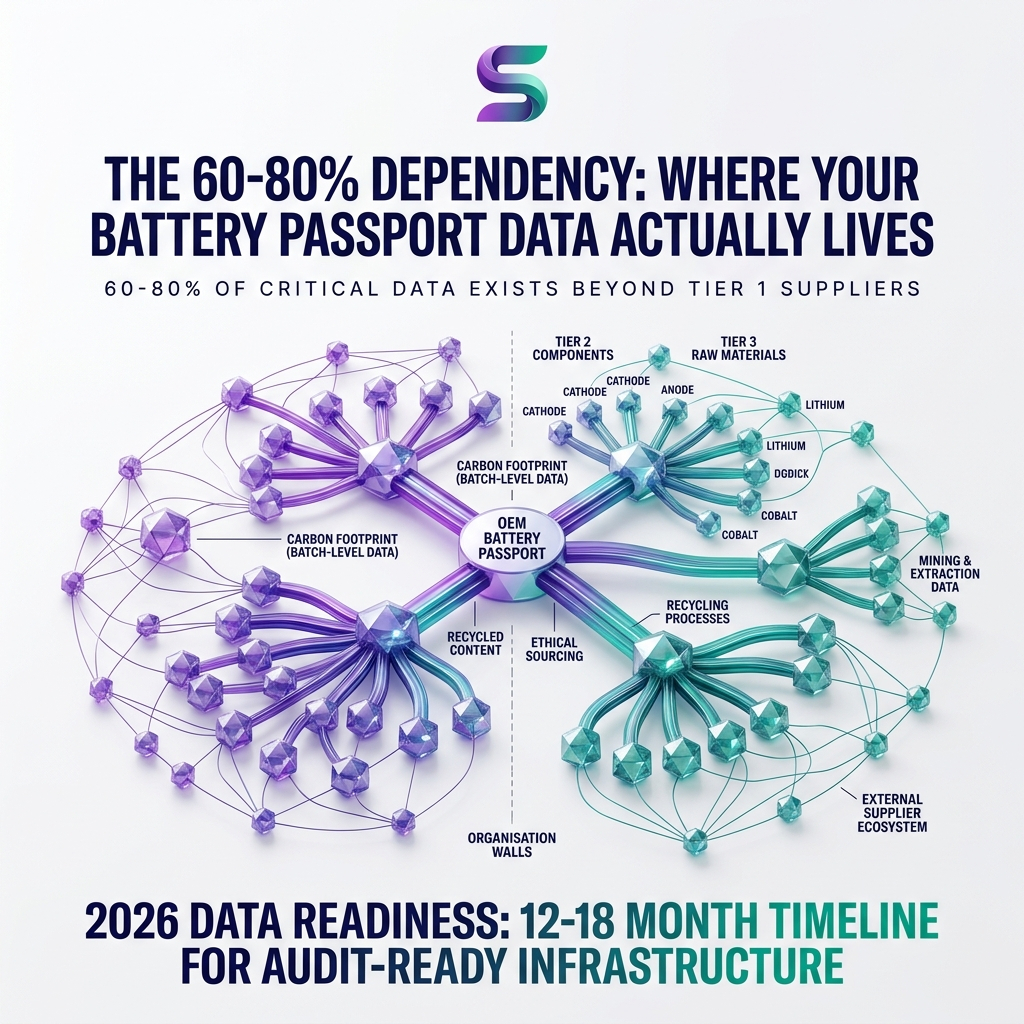
A substantial share of the required data sits outside the OEM's direct control, distributed across multiple supplier tiers. Your Tier 1 battery cell manufacturer needs data from Tier 2 component suppliers, who need data from Tier 3 raw material miners and recyclers.
2026 Is the Data Readiness Year Most Organisations Haven't Planned For
This is a dependency chain most organisations haven't mapped. Teams assume data exists somewhere in the system. They discover too late the data doesn't exist, or exists in a format they cannot verify during third-party audit.
No single entity holds all the information.
The mid-cycle problem makes this worse. Programmes that selected suppliers in 2023 or 2024 chose against the data requirements that existed then. Many of those suppliers, particularly Tier 2 and Tier 3, were never contracted to provide the level of traceability the Battery Passport now demands. Retrofitting those data obligations into existing supplier contracts is not a clean exercise. It involves renegotiation, sometimes resourcing, occasionally re-sourcing. None of these are fast.
This is where the retrofit cost lands.
The regulation is in effect. The real pressure point arrives in 2026.
Industry analysts estimate a 12-18 month timeline to establish the data infrastructure. Organisations need to start now to be ready for 2027 compliance.
Where Manual Systems Collapse Under Audit Pressure
Here's what most organisations haven't factored in.
The regulation requires third-party verification for carbon footprint declarations, recycled content declarations, and supply chain due diligence. Verification capacity in Europe is limited relative to the volume of batteries needing certification.
This creates a bottleneck no one is discussing.
Organisations focus on generating data. The verification infrastructure creates an unacknowledged constraint. I've watched this pattern in thermal systems validation. The testing capacity becomes the critical path, and organisations who haven't secured their verification partners early find themselves queuing behind competitors who planned ahead.
The compounding factor is that notified bodies and accredited verifiers don't only serve the Battery Passport. They serve every other regulatory regime that demands third-party assurance. It is a sector-wide capacity problem that the Battery Passport intensifies.
The verification bottleneck extends far beyond batteries.
I'm seeing organisations attempt to manage Battery Passport requirements through manual data entry and spreadsheets.
The Global Compliance Ripple Most Suppliers Haven't Prepared For
This approach works at small scale. Things break when execution layers multiply.
The EU Battery Regulation requires third-party verification. An auditor will not accept a manual spreadsheet as proof of a verified carbon footprint or ethical sourcing. The regulation demands every kilogram of CO2 equivalent declared must be traceable back to an activity, a process, a supplier, a site, and a dataset.
This level of granularity exposes what I call the absence detection gap.
The absence detection gap is the difference between what you think you know and what you prove under audit. Most organisations discover this gap too late, when they're in the verification process and the auditor asks for documentation they should have captured eighteen months earlier.
The JRC's methodology for calculating and verifying carbon footprints requires site-specific and batch-level data for each manufacturing facility. Carbon offsets cannot reduce reported emissions.
This isn't a data collection problem. This is a data architecture problem.
When Missing Data Cascades Into Market Access Failure
And for programmes already in validation, it is a retrofit problem. Data architectures designed in 2022 were not designed to surface batch-level traceability for every supplier tier. Bolting that capability onto a live programme is materially harder than designing for it from the start.
The Battery Passport regulation extends beyond European manufacturers.
Non-EU producers who want to access the European market will need to comply. This creates ripple effects across mining, refining, and recycling industries worldwide.
Smaller cell manufacturers and non-EU suppliers face a choice. Invest in compliance infrastructure, participate in industry consortia, or adopt third-party digital passport platforms. The alternative is market exclusion.
When a major market implements new standards, the entire supply chain must adapt. Suppliers who delay preparation find themselves locked out. Competitors who invested early capture market share.
Your compliance depends on suppliers who may not have begun preparing.
The Blueprint for Every Future Product Passport
This is the dependency risk most organisations haven't mapped. You might have perfect internal processes, but if your Tier 2 supplier in Southeast Asia hasn't established their data infrastructure, your Battery Passport is incomplete.
For programmes mid-cycle, this is the most exposed flank. Supplier selections made under earlier compliance assumptions may need to be revisited. Some Tier 2 and Tier 3 suppliers will not make the transition in time. The cost of switching, mid-validation, is not theoretical.
The consequences of incomplete passport data extend beyond regulatory penalties.
Supply chain partners may refuse to integrate non-compliant batteries into vehicles or energy storage systems because of regulatory risk. Vehicle manufacturers may hesitate to install batteries with compliance uncertainty. Energy storage developers may delay procurement if they cannot verify lifecycle information.
This is execution failure cascading into business failure.
What the Industry Actually Needs
A missing verification artefact at the component level blocks vehicle certification. The programme slips the launch gate. Market share is lost to competitors who executed their validation process correctly.
The Battery Passport follows the same logic. Missing or incomplete passport data leads to financial penalties, regulatory intervention, and restrictions on placing products on the European market.
The programmes most exposed are not the ones that haven't started. They are the ones that started under the old assumptions and are now too far in to absorb a clean restart.
That distinction matters.
The Battery Passport isn't an isolated requirement.
The Battery Passport is proof-of-concept for the entire EU Digital Product Passport system under the Ecodesign for Sustainable Products Regulation. The technical architecture, enforcement model, and data requirements established here will cascade to textiles, electronics, furniture, and every other product category.
Starting as a regulatory requirement for EV batteries, the digital passport framework is expanding. Full product passports for steel, aluminium, leather, and rubber are on the horizon.
Organisations in other product categories should treat the Battery Passport as a blueprint. The data architecture, enforcement patterns, and compliance challenges will carry over directly to their own requirements.
The Question You Should Be Asking
For organisations in aerospace, heavy machinery, and complex manufacturing, this isn't about batteries. This is the regulatory model coming for your industry next.
And the saturation problem only intensifies. Every new Digital Product Passport adds to the same finite verification capacity, the same supplier-tier dependency complexity, the same mid-cycle programme exposure. The Battery Passport is not the last addition. It is the first of many.
Most coverage of the Battery Passport prescribes more compliance investment. More headcount. More software. More supplier audits.
This prescription misses the structural problem. The industry cannot keep absorbing new compliance layers at the current pace without something giving. The right response is not to comply harder. It is to build systems that surface dependency risk, verification capacity risk, and data architecture risk early enough to actually manage them.
Three things matter.
First, map your full dependency chain now. Not Tier 1 suppliers, but the complete path from raw material extraction through recycling. Identify which suppliers have the technical capability to provide verified data and which don't. Identify which of your current supplier contracts predate the data requirements they will need to meet.
Second, establish data architecture to survive audit. Not spreadsheets, but systems to create traceable, verifiable records at the batch and site level. Systems to document every data point back to the source. For mid-cycle programmes, this means an honest assessment of what can be retrofitted and what cannot.
Third, secure verification capacity early. Identify notified bodies and approved verification partners now, before the 2026 rush creates a bottleneck. Treat verification capacity as a critical-path resource, not a procurement afterthought.
This is the work. Map dependencies before they become crises. Build systems that reveal absence before absence costs years.
Most organisations are asking what the Battery Passport requires.
The organisations who will still be in the European market in 2028 are asking a different question. What breaks in their current system, in their current programmes, in their current supplier base, when they try to meet these requirements under audit conditions while everything else they were already validating continues at pace?
The Battery Passport will expose the same patterns that govern every complex programme under compounding pressure. Organisations who leave execution to chance discover their gaps too late. Organisations who map dependencies, build verification-ready systems, and secure verification capacity early will launch on time, with integrity, and with market access intact.
The choice is whether you discover your execution gaps in 2026, when you have time to fix them, or in 2027, when the market has moved on.
Comments ()