
When Geopolitical Instability Rewrites India's Automotive Economics
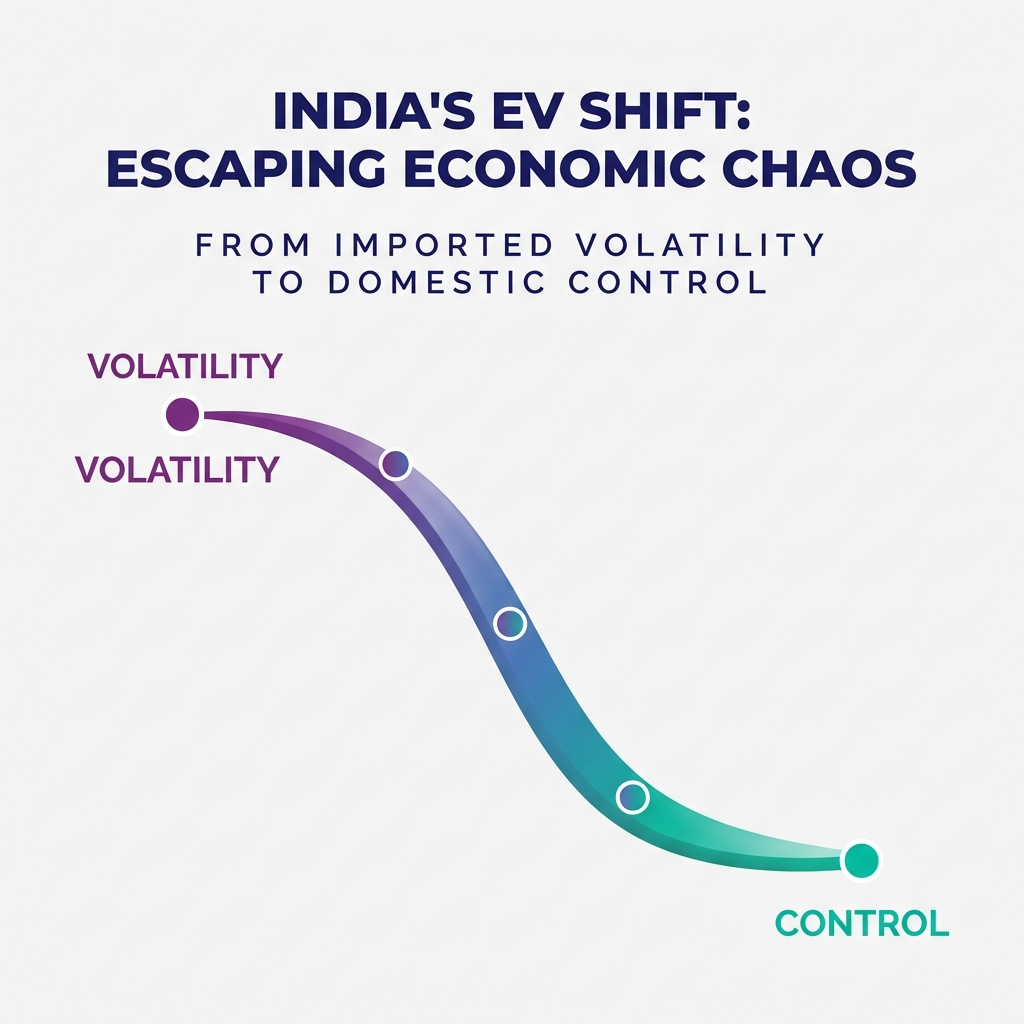
Here's what almost everyone gets wrong about India's electric vehicle shift.
They think it's about saving the planet.
It isn't.
Look at the headlines. Climate policy. OEM rivalry. Consumer trends. Government mandates. Those are the surface ripples.
But underneath? The system is tearing itself apart.
India's mobility economy became exposed to forces it can no longer absorb. The cracks appeared where they always do: at the edge, where people actually depend on vehicles to survive.
Delivery riders working 12-hour shifts. Auto drivers running razor-thin margins. Fleet operators calculating daily profit in rupees, not lakhs. Middle-income families whose commute budget determines what their children eat.
That edge stopped being predictable.
And here's the thing about predictability in India: once it's gone, everything breaks.
So the real transition isn't ICE to EV.
It's volatility to control.
The Multiplication Effect Nobody's Mapping
Want to understand what's really happening?
Start here: crude volatility multiplied by currency volatility.
Not added. Multiplied.
When Brent crude spikes, India needs more dollars to buy the same energy. But here's where it gets nasty: oil is dollar-denominated. So even if crude prices stabilise globally, a weakening rupee still drives up domestic fuel costs.
You're paying more for the same thing twice over.
India's import dependence for crude oil touched 88.2% in FY 2024–25. The country imported around 242.4 million tonnes of crude oil, whilst domestic production dropped to 28.7 million tonnes. India met only 11.8% of its petroleum needs from local sources.
That multiplication effect? It's deadly.
Think about what this means on the ground.
A delivery rider earns in rupees. But pays for globally priced energy through a weakening local currency. Revenue is local. Energy dependency is global.
That mismatch is the structural crack in the system.
For high-utilisation users, fuel isn't discretionary spending. It's EMI capacity, household cash flow, working capital, and the ability to stay on-road tomorrow.
Here's how the maths works in real life.
A gig rider doing 120–180 km daily. Fuel at ₹300/day suddenly becomes ₹420. Then ₹650.
Can they raise prices? No. Swiggy, Zomato, Blinkit, and Amazon control pricing. Customer price elasticity is high. Competition is infinite. Labour oversupply kills bargaining power.
So where does that fuel inflation go?
Straight into the operator's margin. A small fuel cost increase can wipe out most of the day's net earnings.
Now watch what happens next.
Longer working hours. Deferred maintenance. Unsafe driving. Skipped servicing. Loan stress.
Economic stress doesn't stay economic. It propagates into operational reliability.
This is the moment EVs stop looking "green."
They start looking like survival.
Because electricity pricing in India is more locally controllable, less geopolitically exposed, and operationally predictable.
An EV becomes a margin stabilisation mechanism, an energy dependency hedge, and a predictability tool.
When the Vehicle Becomes a Cash-Flow Machine
There's a specific moment when everything shifts.
The buyer stops evaluating the vehicle as a product. They start evaluating it as a cash-flow machine.
Most Indian buyers aren't running spreadsheets on rupee depreciation or currency-denominated commodity inflation.
But they absolutely feel it.
The dependency chain becomes real when volatility stops being occasional and starts becoming behavioural. There's usually a progression.
Phase 1: Fuel pain feels temporary.
Petrol goes from ₹95/litre to ₹102 to ₹108. The buyer tells themselves, "Prices will come back down."
Behaviour doesn't fundamentally change. The consumer still thinks in purchase price, brand, styling, aspiration.
Phase 2: Refilling becomes emotional.
The issue stops being "fuel is expensive." It becomes "I'm refuelling too often."
That distinction matters. A delivery rider doesn't experience fuel economically first. They experience it rhythmically.
Every refill becomes a reminder of income leakage.
The mental calculations begin.
"₹700 again?" "Full tank vanished already?" "All weekend earnings gone into fuel?"
That repetition creates behavioural fatigue. The economics are entering psychology.
Phase 3: Monthly cash flow destabilises.
This is the real trigger point.
Indian middle and working-class consumers optimise around monthly survivability. EMI certainty. Predictable outflows.
Once fuel volatility starts interfering with EMI payments, savings ability, household budgeting, and daily liquidity, something shifts.
The consumer stops searching for technology. They start searching for stability.
This is where EVs suddenly become rational.
Not because "EVs are the future."
But because "I know roughly what my monthly running cost will be."
That predictability itself becomes valuable.
E20: The Technical Change That Becomes an Economic Filter
Now layer E20 fuel standards into this fragile system.
Most consumers hear "20% ethanol blend" and "lower emissions."
What they don't hear: altered combustion characteristics, lower energy density, material compatibility implications, mileage degradation risk.
To an engineer, E20 is a calibration problem.
To a financially stretched user, it's a compounding operating-cost problem.
Ethanol has lower calorific value than petrol. You typically burn more fuel to travel the same distance. Ethanol's lower energy density results in a marginal decrease in mileage, estimated at 1–2% for four-wheelers designed for E10 and calibrated for E20, and around 3–6% in others.
Imagine someone already operating at the edge. A daily commuter. Delivery rider. Small business operator. Older motorcycle owner.
They don't track stoichiometric ratios or combustion thermodynamics.
They track: "Why is my tank empty faster?"
That is the behavioural interface of energy density loss.
If the rider already feels "I'm refuelling too often," E20 can amplify that perception. Especially on older engines, poorly maintained systems, non-optimised calibrations, and heavily utilised two-wheelers.
Then the second-order effects begin. Older ICE vehicles may face rubber/seal degradation, corrosion concerns, injector/carburator sensitivity, cold-start inconsistencies, and increased maintenance frequency.
Not necessarily catastrophic individually. But structurally important collectively.
Because Indian ownership economics are extremely duration-sensitive. People keep vehicles for long periods because replacement cycles are financially stretched, repairability matters, and second-hand markets matter enormously.
Higher-income consumers adapt. They upgrade vehicles, absorb efficiency loss, switch faster, and treat it as inconvenience. Lower-income and high-utilisation users cannot.
That means the economic pressure concentrates hardest where mobility is livelihood-linked, utilisation is highest, and margins are thinnest.
So a technical fuel transition starts behaving like an economic filter.
What OEMs See That Others Don't
Tata. Mahindra. Even Maruti.
They're all launching dedicated EV platforms now. Enormous capital commitments.
What are they seeing that justifies betting billions?
Not "EV adoption growth."
They're seeing the beginning of an ICE demand-quality deterioration curve.
OEMs don't make these bets because Twitter sentiment improved or one year of EV sales spiked.
They commit because they believe the structural direction of the operating environment has changed.
And what they're probably seeing downstream is a convergence of pressures that gradually make ICE platforms harder to defend economically.
Not impossible. Harder.
Fuel economics are becoming structurally volatile. The OEMs can see crude exposure, FX sensitivity, refining economics, urban congestion, emissions tightening, and ethanol blending evolution all converging onto the ICE ownership model. Once lifetime ownership predictability weakens, customer retention weakens too.
The economics of urban mobility are changing faster than consumers realise. India's major cities are becoming denser, slower, more stop-start, more delivery-centric, and more shared-mobility dependent. That environment disproportionately favours EV drivetrains because EV efficiency improves in exactly the conditions where ICE efficiency collapses: stop-go traffic, low-speed duty cycles, regenerative braking environments, short urban loops.
The two-wheeler and fleet transition is the early signal. When fleet operators, delivery networks, urban logistics players, and high-mileage users start transitioning at scale, OEMs interpret that as an early economic signal, not a niche trend. Because high-utilisation users are effectively stress-testing future ownership economics before mainstream consumers do.
They feel economic inefficiency earliest.
They are likely seeing a coming residual-value problem. ICE economics don't collapse linearly. They weaken through resale confidence erosion. Once consumers begin suspecting future fuel uncertainty, stricter emissions norms, compatibility concerns, higher maintenance exposure, and urban restrictions, used ICE valuation psychology changes.
And the moment resale confidence weakens, financing models weaken, leasing economics weaken, upgrade cycles distort, and ownership hesitation rises.
Dedicated skateboard architectures mean the OEM believes the ecosystem itself is reorganising around electrification. That includes software architecture, supply chain topology, thermal systems, manufacturing layout, supplier investments, electronics integration, service ecosystems, and digital ownership models.
You don't rebuild your architecture stack unless you think the industry's centre of gravity is moving.
The Used EV Market: Where Democratisation Actually Happens
Here's what doesn't transform India: those ₹15–20 lakh EVs.
Here's what does: the second owner buying electric. The delivery rider buying electric. The family upgrading from a 10-year-old hatchback. Financing institutions becoming comfortable underwriting electric residual value.
That is when the transition becomes systemic instead of symbolic.
The used EV market solves the exact behavioural barrier that slows first-hand EV adoption: uncertainty. Not just affordability. Uncertainty.
Right now, consumers fear battery replacement cost, resale uncertainty, and long-term reliability. The first buyer absorbs that fear. The second buyer benefits from the learning curve.
India is fundamentally a monthly affordability market. Not a sticker-price market.
A used EV suddenly changes the equation because lower acquisition cost, lower running cost, lower maintenance variability, and predictable urban utilisation economics begin aligning together.
Imagine a 5-year-old EV hatchback with battery health certified, financed through NBFCs, predictable charging access, and a city commuting use case. Suddenly the comparison is no longer "new EV vs used ICE." It becomes "predictable monthly cost vs unpredictable monthly cost."
That is an entirely different behavioural framing.
The used EV ecosystem only scales if battery diagnostics standardise, financing models adapt, and trust infrastructure emerges. Meaning certified battery SOH (state of health), degradation prediction, warranty portability, residual-value modelling, and refurbishment ecosystems.
The moment this infrastructure matures, used EV adoption accelerates dramatically. Because consumers no longer buy "an EV." They buy a certified energy-storage asset with predictable operating economics.
The used EV market may actually become the force that destabilises ICE resale economics. Because once a used EV starts offering lower monthly operating cost, lower maintenance uncertainty, and lower energy volatility exposure than a comparable used ICE vehicle, the traditional ICE second-hand advantage weakens.
That is an enormous shift. Because India's automotive system has historically depended on strong used ICE circulation to keep new sales moving. If that circulation weakens structurally, OEM strategy changes very quickly.
The Failure Mode Nobody's Preparing For
The transition breaks if EVs stop feeling predictable.
That's the core risk.
The whole argument rests on EVs becoming the more stable economic asset. If that stability promise cracks, the adoption curve slows hard.
Here's the assumption that will surface painfully in 3–5 years: that EV adoption is mainly a vehicle-and-charging problem.
It isn't.
It's an asset-confidence problem.
When the first meaningful wave of Indian EVs enters the second-owner market, the question shifts.
From "Should I buy an EV?"
To "Can I trust this used EV with my monthly cash flow?"
Everyone's building the visible layer. Platforms. Range claims. Chargers. Launch pipelines. Localisation announcements.
But the invisible layer is weaker.
Standardised battery SOH certification. Transparent degradation history. Transferable battery warranties. Battery repair/refurbishment economics. Insurer confidence. NBFC underwriting logic. Used EV valuation models. Independent service capability.
India's mobility market doesn't democratise through first owners alone. It democratises through the resale ladder.
If the resale ladder is weak, the whole system gets distorted. First buyers hesitate because residuals are unclear. Second buyers hesitate because battery risk is opaque. Financiers hesitate because collateral value is uncertain. Insurers hesitate because repair economics are unclear. Fleet operators hesitate because downtime risk is unknown.
Then EVs risk becoming good products with weak asset behaviour.
Here's the death spiral: EVs become seen as cheap to run, but risky to own.
Because Indian buyers will tolerate high running cost if the asset feels dependable.
But they won't tolerate uncertainty around a financed asset that supports daily mobility or income.
Geopolitical Pressure Forces Acceleration
Geopolitical instability simultaneously accelerates the transition timeline whilst also increasing the probability of execution fragility. External pressure removes the luxury of gradual adaptation.
Every major disruption—Middle East conflict, Red Sea shipping disruption, sanctions, semiconductor restrictions, lithium nationalism, rare-earth controls, currency fragmentation, oil supply uncertainty—is effectively telling countries that global dependency chains are no longer stable enough to assume continuity.
That changes industrial behaviour immediately.
The ICE ecosystem was built during an era of predictable oil flows, stable shipping, long-cycle manufacturing, global supplier optimisation, just-in-time logistics, and relatively stable energy assumptions. That world is weakening.
And once stability assumptions weaken, countries start prioritising controllability, localisation, energy sovereignty, supply-chain redundancy, and domestic manufacturing capability.
EVs align with that logic far more naturally than ICE. Because electricity can be generated domestically, diversified across sources, distributed locally, increasingly renewable, and partially insulated from maritime chokepoints.
But the pressure compresses timelines faster than ecosystems naturally mature. That creates forced acceleration. And forced acceleration produces fragility.
India is attempting three transitions simultaneously: energy transition (reducing imported fuel dependency), industrial transition (building domestic manufacturing capability), and economic-access transition (ensuring mobility remains affordable for a price-sensitive population).
Those three goals don't always move cleanly together. Localisation initially increases costs. Battery imports create new dependencies. Charging rollout is uneven. Grid readiness varies massively. Financing maturity lags product launches.
So the country is effectively trying to redesign mobility, energy, manufacturing, infrastructure, and financing all at once. That is a systems-scale transformation.
Pressure forces the ecosystem to solve problems it might otherwise postpone. But forced maturity isn't the same as graceful maturity. Some layers mature quickly: platform investment, policy support, manufacturing announcements. Other layers lag badly: repair ecosystems, resale markets, grid resilience, technician depth, recycling systems, financing sophistication.
That creates transition asymmetry.
Geopolitical pressure changes the psychology of governments and industries from "optimise efficiency" to "preserve resilience." That is a massive civilisational transition.
India's Utilisation-Led Adoption Curve
India's EV curve will look less like the West and more like a bottom-up mobility inversion. In the West, adoption started from premium passenger cars: Tesla, company cars, tax incentives, home charging, lifestyle signalling.
India's curve is different. It will be led by 3-wheelers, 2-wheelers, fleets/delivery, buses, affordable passenger cars, and the used EV resale market.
India retained its position as the world's largest market for electric three-wheelers for the second consecutive year in 2024, with sales rising nearly 20% to approximately 700,000 vehicles and achieving a record 57% electric share.
Electric two-wheelers led the charge in CY2024, dominating the market with nearly 60% of total electric vehicle sales in India (1.2 million units), enjoying robust year-on-year growth of approximately 30%.
That means India may look "behind" the West in passenger-car EV share, but ahead in practical electrification of daily mobility.
The West adopted EVs when EVs became desirable. India adopts EVs when ICE becomes economically unstable. That gives India a slower passenger-car curve, but a potentially faster real-world mobility curve.
By 2030, electric 3-wheelers could become the dominant new-sale category. Electric 2-wheelers may move from early adoption to mainstream, especially in urban and southern/western states. Passenger EVs may still be lower than China/Europe, possibly in the 10–25% zone unless price, charging, and finance improve faster. Used EVs become the real democratisation layer.
By 2035, India's EV market could be structurally mature in high-utilisation segments, even if private cars remain mixed. The market won't be "all EV." It will be segmented: urban high-utilisation strongly electric, rural/long-distance/private low-utilisation a hybrid/CNG/ICE/EV mix, commercial last-mile heavily electric, and premium/private cars increasingly EV but not the core adoption engine.
The Flip Side Nobody Discusses
What India is actually doing is not eliminating externalities. It's shifting where the externalities sit inside the system.
A large portion of India's electricity still comes from coal, natural gas, and fossil-heavy grid inputs. So in many cases, the tailpipe disappears, but the smokestack remains.
That doesn't mean EVs are pointless. But it changes the nature of the transition. Instead of millions of distributed combustion sources, the system centralises energy generation into the grid.
That has advantages: grid optimisation, renewable integration potential, controllability, efficiency scaling, energy diversification. But it also creates new dependencies: grid stability, peak demand management, transmission infrastructure, coal logistics, and electricity pricing politics.
Right now EV economics work partly because electricity is relatively cheap compared to petrol/diesel. But as EV penetration rises, charging demand rises, grid stress rises, infrastructure capex rises, utilities seek recovery mechanisms, and commercial charging operators seek margin.
Eventually electricity pricing itself becomes political. The danger is EVs escape fuel volatility only to enter electricity volatility later.
The battery-disposal issue is massively underestimated. Right now, the market is focused on selling EVs, building chargers, and scaling batteries. But very few consumers are emotionally processing what happens to millions of ageing lithium-ion batteries.
If charging is energy inflow infrastructure, then recycling/refurbishment is material outflow infrastructure. Without that second layer, the system becomes incomplete.
A mature EV ecosystem eventually requires battery collection systems, state-of-health grading, second-life energy storage, recycling plants, hazardous material handling, lithium/nickel/cobalt recovery, informal-sector integration, and traceability frameworks.
India currently doesn't have this at the scale future adoption requires. And India's informal recycling economy adds another layer of risk: unsafe dismantling, fire hazards, toxic leakage, and unregulated recovery chains.
The real transition isn't ICE to EV. It's one dependency architecture replacing another.
The question isn't "Will EVs create new problems?" They absolutely will. The real question is "Are those new problems more controllable than the old ones?"
And strategically, many governments believe the answer is yes. Because electricity can be domestically generated, grids can diversify over time, batteries can theoretically recycle, and energy sources can evolve. Whereas crude dependence is externally priced, geopolitically exposed, continuously consumptive, and impossible to recover once burned.
Who Actually Wins This Transition
Not the best OEM.
Not the cheapest battery maker.
Not the biggest charging network alone.
The winner is the player that becomes the trust operating system for EV ownership.
The winner is the institution that can make this question boring:
"Can I buy, finance, insure, service, and resell this EV without hidden risk?"
That confidence layer will likely be installed by a coalition, but one type of player is best positioned to lead it: the asset-underwriting player. Meaning the entity that can connect battery health data, vehicle usage history, financing risk, insurance pricing, repair cost, residual value, and resale certification into one trusted score.
In India, that could be an NBFC, insurer, large used-vehicle platform, fleet operator, or OEM-backed finance arm. But the institutional logic is the same: turn technical uncertainty into financial confidence.
OEMs can sell the first EV. Charging networks can reduce usage anxiety. Service networks can reduce repair anxiety. But the player who can say "This EV is worth ₹X, financeable at Y rate, insurable at Z premium, with verified battery health and predictable remaining life" controls the resale layer.
And the resale layer controls democratisation.
The winner isn't the player who makes EVs desirable. It's the player who makes EVs bankable. India's EV transition won't be democratised by aspiration. It will be democratised by underwriting.
The real power will sit with whoever converts battery uncertainty into collateral confidence.
What Will Be Obvious in Hindsight
Years from now, this will seem clear.
India's EV transition was never fundamentally about decarbonisation.
It was about reducing economic volatility at the edge of the system.
Most analysis still treats this as technology adoption. Climate policy. OEM competition. Charging rollout. Consumer preference shifts.
Those are the visible layers.
But underneath? The system is reorganising because too many parts of India's mobility economy became exposed to variables they could no longer absorb predictably.
Imported fuel volatility. Currency exposure. Utilisation stress. Emissions compliance cost. Urban congestion inefficiency. Maintenance complexity. Geopolitical instability.
The pressure accumulated at the edge.
Delivery riders. Auto drivers. Fleet operators. Middle-income commuters. Logistics networks. Financing ecosystems.
That edge started losing predictability.
And once mobility stops feeling predictable, it stops feeling economically safe.
So the transition isn't actually ICE to EV. It's volatility exposure to controllability.
That's the deeper shift almost nobody frames correctly today. Because when you look through that lens, a lot of confusing things suddenly make sense.
When you look through that lens, a lot of confusing things suddenly make sense:
Why two-wheelers matter more than luxury EVs.
Why fleet adoption signals more than showroom sentiment.
Why charging reliability matters more than futuristic features.
Why used EV trust becomes existential.
Why financiers become more important than marketers.
Why geopolitical instability accelerates electrification.
Why localisation matters.
Why battery certification becomes infrastructure.
Why "cheap to run but risky to own" is fatal.
Why the second owner matters more than the first.
All of those are manifestations of the same systems-level force:
India is trying to make mobility economically predictable again.
And the reason this remains invisible in current analysis? Most frameworks still analyse EVs as products.
But in India, EVs are increasingly behaving as cash-flow stabilisers, energy-risk hedges, utilisation optimisers, and volatility buffers.
That is a completely different category.
The industry thinks it's selling electric vehicles.
What it may actually be building is a lower-volatility mobility system.
And years from now, I suspect people will realise the transition accelerated not when EVs became aspirational enough.
But when ICE economics became unstable enough that predictability itself became the premium product.
Comments ()